*First Published on The Refugee Platform in Egypt
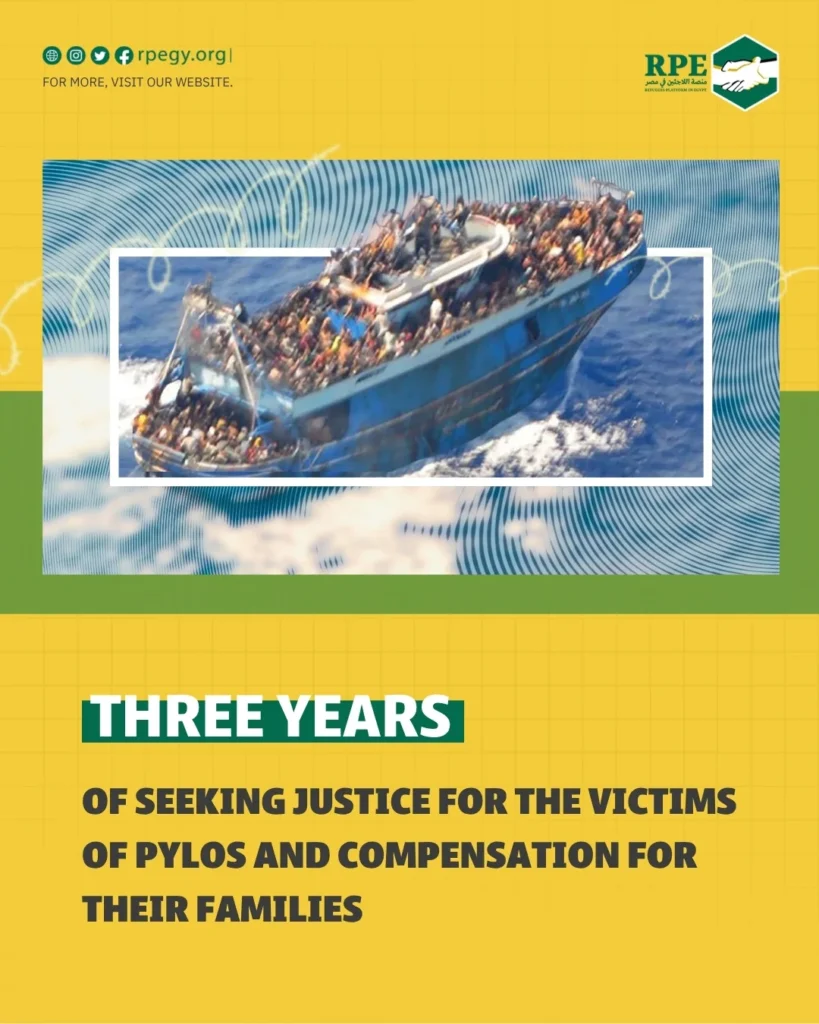
The Refugee Platform in Egypt is monitoring judicial and human rights developments related to the sinking of the fishing boat ‘Adriana’ off the coast of Pylos, Greece, on June 14th, 2023, a tragedy that marks its third anniversary today. The disaster claimed the lives of hundreds of forcibly displaced people, including a large number of forcibly displaced Egyptian citizens, in one of the deadliest maritime tragedies in the Mediterranean Sea in recent decades.
From the very beginning of the disaster, it was clear that this was not an accidental sinking or an isolated technical failure; rather it was a series of developments that raised grave suspicions regarding inaction during rescue efforts; mismanagement of maritime response activity; intimidation of forcibly displaced people during their rescue by the Greek Coast Guard; and attempts to shift the blame for the tragedy onto some of the survivors themselves. This all took place while evidence of the Greek Coast Guard’s institutional responsibility gradually came to light through survivors’ testimonies, journalistic investigations, human rights reports, and subsequent official inquiries.
The ship ‘Adriana’ capsized in the early hours of the morning on June 14th, 2023 after a journey that began in Libya with approximately 750 forcibly displaced people on board, the majority of whom were forcibly displaced Egyptian, Syrian, and Pakistani citizens. Only 104 forcibly displaced people survived the disaster; while only 82 deceased people’s bodies were recovered and more than 600 other people were presumed to have been lost at sea.
Accumulating evidence indicates that Greek authorities were aware early on of the boat’s presence and the dangerous condition the boat was in, yet they delayed launching an adequate search and rescue operation even though the incident occurred within the Greek search and rescue region. This decision therefore imposed clear legal responsibilities on Greece under international maritime law and international conventions on maritime search and rescue.
Growing Evidence of the Greek Coast Guard’s Culpability
In the months and years following the disaster, evidence continued to emerge that undermined the official Greek authorities’ account, which claimed that the ship’s passengers had not called for help and had insisted on continuing their voyage to Italy. Numerous human rights and journalistic reports documented testimonies from survivors who confirmed that they had repeatedly requested assistance and that Greek authorities were aware the ship was in danger; some testimonies even directly attributed to the coast guard the act of tying a rope to the ship or attempting to tow it before it capsized.
As a result, the findings of independent official investigations take on particular significance. The Greek Ombudsman’s report, issued in February 2025, concluded that there were serious and repeated failures in search and rescue operations. Furthermore, the report held eight senior Greek Coast Guard officers blatantly responsible, noting major obstacles that hindered the investigation including the absence of legally required communication records; failing to make the naval unit commander’s phone available for the investigation; and the malfunction of the ship’s cameras at the time of the incident, according to the authorities.
The Frontex Fundamental Rights Office’s incident report, released in January 2024, also concluded that the Greek Coast Guard delayed announcing the search and rescue operation until the moment of the sinking and deployed insufficient and inappropriate resources given the number of people on board the ‘Adriana’. These findings confirm that the issue is not a matter of a simple error in judgment, but rather a systemic failure in risk assessment and response as well as operational decisions that may have directly contributed to the severity of the disaster and the loss of hundreds of lives.
From Criminalizing Survivors to Holding Officers Accountable
Immediately following the disaster, Greek authorities arrested nine Egyptian survivors and charged them with extremely serious offenses, including human trafficking, causing the ship to sink, and membership in a criminal organization. From the outset, this move represented an egregious example of criminalizing victims and survivors rather than protecting and listening to them as witnesses to a mass disaster. This course of action was based on preliminary statements and testimonies taken under extremely precarious circumstances while many of the survivors were in a state of psychological and physical shock. This was also executed amid strong suspicions that the authorities that collected some of those statements were the very same authorities that were later accused of dereliction of responsibility and negligence.
On May 21st, 2024, the Three-Judge Criminal Court of Appeals in Kalamata dropped all charges against the nine individuals arrested in the Pylos case. The court also ruled that the Greek state lacked jurisdiction to try the nine-person group on charges related to criminal organization and causing the sinking, because the events that led to the sinking of the ‘Adriana’ occurred in international waters. The court also dismissed the charges of ‘smuggling and illegal entry into national territory’ after concluding that the passengers of the ‘Adriana’ had not actually entered Greek territory and had no intention of doing so.
This ruling represents an important, albeit belated, correction to a judicial process that was based on unfair assumptions regarding the forcibly displaced Egyptian citizens who survived the disaster. Nevertheless, it does not undo the grave harm they suffered as a result of their prolonged pretrial detention, nor does it negate the fact that the Greek state kept them in administrative detention after the verdict, even though the court acquitted them of all charges.
According to available human rights sources, eight of the nine-person group remained detained pending asylum interviews, while the ninth survivor, a 20-year-old man, was transferred to the Petrou Ralli Center and threatened with deportation to Egypt after his asylum application was rejected twice.
The continued detention of the survivors after their acquittal clearly reveals that the logic of deterrence and punishment continues to govern immigration and asylum policies in a way that transcends the criminal justice system itself. This ongoing detention transforms administrative detention into a tool for punishing witnesses and survivors rather than providing them with care as well as psychological and legal support. This practice has been documented in the cases of hundreds of forcibly displaced Egyptian citizens who were arrested in Greece in similar contexts.
Recent Judicial Developments in Greece
After a long period of impunity, signs of criminal accountability are beginning to emerge against the Greek Coast Guard. In May 2025, 17 members of the Greek Coast Guard were referred for criminal investigation on charges including causing a shipwreck that claimed the lives of at least 82 people; gravely compromising maritime safety which resulted in deaths; and failing to fulfill their legal duty to rescue people in distress at sea.
Then, in November 2025, a crucial development took place when the Prosecutor General of the Greek Court of Appeals expanded the scope of the prosecution to include four additional senior officers, among them the current commander of the Greek Coast Guard, Trifonas Kontizas bringing the total number of officers under investigation to 21. This judicial expansion reflects an important acknowledgment that potential liability is not limited to the immediate operational level at the scene of the incident, but may extend to the command, supervisory, and decision-making levels within the Greek Coast Guard itself.
Nonetheless, these developments, important as they are, do not mean that justice has been served. To date, there has been no final trial that has publicly revealed the sequence of events, orders, communications, and decisions made from the time the boat was spotted until it sank. Moreover, the right to the truth for the survivors and the victims’ families remains unfulfilled, as long as all the facts have not been presented in a comprehensive public judicial proceeding.
Responsibilities of the Egyptian Government
RPEGY emphasizes that the responsibility for ensuring justice for the victims of the Pylos incident does not rest solely with the Greek authorities. The Egyptian government, for its part, bears direct obligations toward the forcibly displaced Egyptian victims and their families, whether in terms of effective consular follow-up; the right to knowledge of the truth; the provision of legal and psychological support; or the implementation of mechanisms for redress and compensation. This can include but is not limited to support for the a victim protection fund for victims, whistleblowers, and witnesses, as well as expanding the role of national councils in empowering families in their various capacities.
Although the Egyptian authorities have conducted investigations into the incident that confirm the innocence of the forcibly displaced Egyptian citizens who were detained, previous reports have revealed delays in the official Egyptian response following the disaster; a lack of transparency regarding the results of DNA tests; and a failure to announce concrete results regarding the identification of victims or to establish a clear mechanism for compensating affected families. Furthermore, it remains unclear to what extent Egyptian authorities provided organized support to forcibly displaced Egyptian citizens who survived and faced charges in Greece or to the families of the victims and the missing, many of whom were left to face this tragedy without adequate legal and institutional support.
The right to redress is not limited to financial compensation; it also includes the right to the truth, official acknowledgment of the violation, access to information, psychological and social support, and guarantees of non-repetition. Therefore, any tangible response from Egypt must include a transparent announcement of the results of the DNA analysis, specifying the number of forcibly displaced Egyptian victims who were identified as well as the forcibly displaced Egyptian citizens who were on board the boat and are now listed as missing. Moreover, a tangible response from Egypt must also include the provision of clear pathways to support families in relevant judicial and administrative proceedings both within Greece as well as abroad.
Broader European Culpability
The Pylos disaster cannot be separated from the broader framework of the European Union’s immigration and border policies. The facts surrounding Frontex’s repeated offers of assistance, as well as the lack of an adequate response to them, revealed an institutional failure that extends beyond the Greek authorities alone and demonstrates how the EU’s southern maritime borders are managed as well as how the logic of deterrence and containment takes precedence over the logic of rescue and the protection of life.
Furthermore, the persistence of deadly border violence in the Mediterranean Sea including subsequent deaths and disappearances along Greece’s maritime borders confirms that the Pylos incident was not an isolated exception, but rather a serious crime that occurred within the broader context of policies that make death at sea a recurring and predictable outcome. Consequently, justice in the Pylos case must also be understood as a test of the credibility of Europe’s legal and humanitarian commitments in the Mediterranean Sea.
Urgent Demands
Based on the foregoing, the Refugee Platform in Egypt demands the following:
- Establish a public and effective judicial process in Greece that ensures full accountability for the Pylos disaster and guarantees that all those responsible, both directly and indirectly, are held accountable for failing to rescue the victims, causing the drowning, tampering with evidence, or obstructing the investigation.
- Halt any actions by Greek authorities that would expose the nine survivors to deportation or forced return, while providing them with specialized legal and psychological protection as survivors as well as key witnesses in the case.
- The Egyptian government must urgently and transparently announce the results of the DNA tests, and disclose its findings regarding the forcibly displaced Egyptian victims and missing people as well as all related reports; and activate effective mechanisms for redress, including compensation and psychological, social, and legal support for the families of victims and survivors, including the activation of a fund for the protection of victims, whistleblowers, and witnesses as well as implementation of specialized national councils.
- Enable the families of victims and survivors, as well as their legal representatives, to access information, files, and procedures related to the case, and ensure their effective participation in the processes of justice and accountability.
- Conduct an independent and comprehensive review of search and rescue and border interception policies in Greece and the European Union, as well as ensure that the protection of life at sea is a legal obligation that is non-negotiable and cannot be subject to political obstruction.
- Cease the use of anti-smuggling laws to criminalize survivors, refugees, migrants, and asylum seekers when these laws are used to justify official failures to rescue people or to divert attention from the authorities’ responsibility.
A Final Word
The Pylos case is no longer merely a legal matter concerning a ship that sank at sea; it has become a central issue in the conflict between the logic of border protection and the logic of human protection. Any delay in uncovering the truth, holding those responsible to account, or providing justice to the victims’ families only serves to entrench impunity and keep the Mediterranean Sea an open space for organized death at the borders.
The Refugee Platform in Egypt affirms that justice for the victims of the Pylos disaster begins with the recognition that those who lost their lives were not mere numbers in an immigration registry, but people with names, families, and rights. Justice also begins with an end to the punishment of survivors and by compelling the states involved, first and foremost Greece and Egypt as well as the institutions of the European Union implicitly, to fully assume their legal and humanitarian responsibilities and to guarantee the right to truth, accountability, reparations, and non-repetition.